
Table of Contents
2014–2022: From One-Party Dominance to a Peaceful Transfer of Power
Between 2014 and 2022 Fiji crossed a political bridge: from a powerful post-coup incumbent winning big under a brand-new system, to a competitive multi-party landscape that finally delivered a peaceful change of government. For Indo-Fijians, these years carried a complex mix of relief and calculation. The 2013 Constitution ended communal voting and promised equal citizenship; but it also arose from a military coup. The test would be the ballot box. Three general elections later, the electorate had its say—first by consolidating FijiFirst’s rule (2014, 2018), and then by replacing it with an opposition coalition (2022). This is the story of how a new electoral system matured, how Indo-Fijian voting blocs shifted, and how Fiji found its democratic footing again.
The New Rules of the Game
The 2013 Constitution reset Fiji’s politics. It abolished communal seats and introduced a single national constituency with open-list proportional representation. Every vote counted equally, and parties crossed the threshold through national totals rather than ethnic quotas. For Indo-Fijians, this was the long-sought one person, one vote principle, finally realised after a century of struggle. But equal ballots were only the beginning; the deeper test was whether voters trusted the system enough to alternate power without force.
The other structural shift was leadership branding. Frank Bainimarama, the coup leader turned civilian prime minister, framed himself as the guarantor of a non-racial future. Many Indo-Fijians—long disadvantaged by communalism—responded. In the first two cycles, FijiFirst built strong support across Indo-Fijian urban centres, cane belts, and professional classes, while opposition parties regrouped under the Social Democratic Liberal Party (SODELPA), the National Federation Party (NFP), and eventually the People’s Alliance (PA).
2014: The Return to the Ballot Box
The 2014 poll—the first since 2006—was a referendum on Bainimarama’s promise: erase ethnic politics, deliver services, and stabilise the economy. The result was emphatic. FijiFirst won decisively; Bainimarama topped the national tally by a huge personal vote, and Aiyaz Sayed-Khaiyum placed third overall—an unmistakable signal of strong Indo-Fijian backing. The opposition vote split between SODELPA (indigenous heartlands) and NFP (rebuilding its Indo-Fijian base). For Indo-Fijians, 2014 felt like a pragmatic bet: lock in equal voting, keep the peace, and extract development dividends while the new system beds down.
2018: A Tighter Race, the Same Outcome
By 2018, politics had normalised. The opposition had learned the rules of a national list. The contest tightened, but FijiFirst still finished ahead, helped by Bainimarama’s personal vote and the party’s organisational discipline. The NFP improved its position; SODELPA remained the principal indigenous-leaning challenger. The map was more competitive, the result less lopsided—but incumbency held. For Indo-Fijians, the calculation endured: the party that ended communal voting still deserved another term, even if concerns about media limits and centralised power were growing. Candidate-level results again showed FijiFirst’s leaders among the national vote-getters.
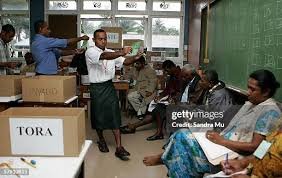
The lesson of 2018 was subtle but important: proportional representation had begun to do its job. It rewarded national outreach, punished parochialism, and forced parties to compete for diverse urban and peri-urban voters—including young Indo-Fijians with no living memory of communal rolls.
2022: When the Numbers Finally Shifted
In 2022, voters delivered a different verdict. FijiFirst still polled strongly, but the combined opposition—People’s Alliance (PA), NFP, and SODELPA—amassed enough seats to form a coalition government. The storyline wasn’t a landslide; it was arithmetic: three parties, one majority. At the level of the popular vote, the election was close; at the level of parliamentary maths, it was decisive. Coalition talks, tense but constitutional, produced a transfer of power and a new prime minister, Sitiveni Rabuka, with NFP’s Biman Prasad central to the arrangement.
What changed? Several currents converged: pandemic-era economic pain; appetite for checks and balances after two terms of compressed executive power; and the maturation of opposition brands able to speak beyond old ethnic frames. Indo-Fijian votes were pivotal—some staying with FijiFirst for stability and service delivery, others swinging to NFP/PA for pluralism and reset. The candidate vote ledger captures the tightness at the top: Bainimarama again led, with Rabuka, Aiyaz Sayed-Khaiyum, Lynda Tabuya and Biman Prasad among the strongest national performers—evidence of a highly competitive field.
What It Meant for Indo-Fijians
For a century, Indo-Fijian politics navigated a trap: security without equality (colonial communalism), or equality without security (when coups punished their success). The elections of 2014, 2018 and 2022 suggested the trap can be escaped. Equal ballots are no longer theoretical; they work in practice. Indo-Fijian votes now swing outcomes across the national list, not just in cane belts. Parties court them on policies—prices, jobs, leases, education, healthcare—rather than on ethnic headcounts. And when a government loses its majority, the response is negotiation, not soldiers at Parliament’s door.
That does not mean all is settled. Indo-Fijians still watch lease security, small-business access to credit, and the quality of public services with forensic attention. They also weigh press freedom, policing culture, and the independence of institutions—the “guardrails” that make equality durable. But the core fear that haunted 1987 and 2000—that a result favouring Indo-Fijians would be overturned by force—receded in 2022. The system held. Power changed hands. People went to work the next day.
How the New System Changed Campaigns
Open-list PR reshaped the ground game. Candidates had to build personal national profiles, not just local patronage networks. That rewarded policy clarity, media discipline, and coalition-building. It also created new stars—women candidates and young professionals—who could draw cross-ethnic followings. Indo-Fijian professionals, community organisers, and unionists found new lanes to Parliament without being pigeonholed as “ethnic representatives.”
The other shift was coalition logic. With one national electorate, pre- and post-poll alliances became the decisive chessboard. The NFP proved adept here: smaller than the big brands, but pivotal in both 2018’s parliamentary dynamics and 2022’s coalition arithmetic—precisely the leverage that a rules-based proportional system intends to create.
Democratic Muscle Memory Returns
Perhaps the most important change from 2014 to 2022 was cultural. Elections regained their old authority. Parties learned to concede particular battles and prepare for the next campaign. Civil society and media—constrained at points—kept pushing the boundaries, and the public grew more confident about participation.
Indo-Fijian civil life reflected that confidence: temples and mosques doubled as relief hubs in tough years; school networks kept communities anchored; diaspora links helped families ride out shocks. Politics was again only one arena of Indo-Fijian advancement, alongside education, enterprise, and the arts.
Legacy of 2014–2022
The legacy is twofold. First, proportional representation under a single national roll can deliver both stability and alternation. Fiji saw a commanding government returned once (2018) and then, without rupture, replaced (2022). Second, Indo-Fijian political power now expresses itself through coalitions and policy bargaining rather than communal headcounts. That is not just healthier; it is safer.
If 2014 was the election that validated a new system, and 2018 the one that tested its competitiveness, then 2022 was the one that proved Fiji’s democracy can exhale. The long arc from Girmit to equal suffrage finally bent toward something sturdier than hope: precedent.