

Table of Contents
Professionals & Industry — From Classrooms to Boardrooms
Indo-Fijians entered Fiji’s economy first as labourers, then as farmers, then as shopkeepers. By the mid-20th century a new chapter opened: education turned their children into teachers, lawyers, doctors, engineers, accountants, and industrialists. From chalkboards in rural schools to policy tables in Suva, Indo-Fijian professionals built a bridge between cane fields and corporations, weaving themselves into the fabric of Fiji’s modern economy.
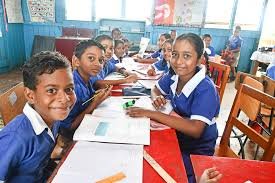
Education as Economic Strategy
For cane farmers who endured seasonal income and uncertain leases, education was the surest investment. “We cut cane so our children won’t have to” was not only a slogan but a household creed. By the 1950s, Indo-Fijian communities had built a lattice of primary and secondary schools, often under the banners of Sanatan, Arya Samaj, or Muslim organisations. Teachers were trained locally and abroad, creating a profession that soon became the backbone of rural advancement.
Scholarships, sometimes funded by temple offerings or bazaar proceeds, sent bright students overseas — to India, Australia, New Zealand, Britain. They returned with degrees and networks, raising the ambition of the next cohort. By the 1970s, Indo-Fijians dominated the teaching service, accounting, medicine, pharmacy, and the civil service’s technical ranks.
Most accessible profession; women especially entered through teaching colleges in Suva & Lautoka.
From A.D. Patel to Jai Ram Reddy, lawyers became both courtroom advocates and political leaders.
CWM Hospital, later USP’s medical school, saw large Indo-Fijian enrolments from the 1960s.
Chartered accountants and managers fuelled Fiji’s modern finance sector.
Teachers and Civil Servants
Teaching was often the first professional step. A daughter with a teaching certificate stabilised the household income, paid siblings’ fees, and became a respected community leader. Indo-Fijian teachers filled classrooms across rural Fiji, often teaching multi-ethnic classes in English and Hindi. They carried chalk in their bags and dignity in their gait.
From teaching many moved into the civil service. Clerks, administrators, and technical officers became a generation of middle managers who kept Fiji’s post-independence bureaucracy humming.
They brought habits of punctuality, meticulous record-keeping, and belief in merit.
“A school certificate was more than paper — it was the passport from cane rows to careers.”
Law, Advocacy and Politics
The courtroom became a theatre of Indo-Fijian assertiveness. Lawyers such as A.D. Patel, K.C. Ramrakha, Jai Ram Reddy and Mahendra Chaudhry used the law not just to defend clients but to advocate for equal political rights. Law practice merged into union leadership and political platforms, making the legal profession one of the most influential routes for Indo-Fijian public leadership.
By the 1980s Indo-Fijian lawyers headed firms, argued constitutional cases, and negotiated contracts for multinational corporations. The confidence learned in cross-examination spilled
into parliamentary debate and international diplomacy.
Medicine and Health
Doctors and nurses carried Indo-Fijian commitment to service into hospitals and clinics. Colonial War Memorial Hospital trained dozens who later staffed rural health centres. By the 1970s and 1980s Indo-Fijian doctors were prominent in general practice, paediatrics, gynaecology, and pharmacy. Many migrated later, but their early decades strengthened Fiji’s public health system.
Women excelled in nursing, midwifery, and laboratory science, often balancing long shifts with household responsibilities. A nurse’s wage, like a teacher’s, stabilised families navigating the uncertainties of cane farming.
Business and Industry
While retail remained the backbone of Indo-Fijian commerce, some entrepreneurs reached further into manufacturing, textiles, food processing, and construction. From garment factories in Lautoka to sawmills in Labasa, Indo-Fijians added industrial capacity to an economy long dependent on agriculture.
Banks and insurance firms also saw Indo-Fijian talent rise. Accountants and managers introduced disciplined systems and customer service norms that became benchmarks. The Suva Chamber of Commerce and other bodies gradually reflected their presence, influencing trade policy and industrial relations.
Case Study: Garment Industry Boom
In the 1980s garment factories multiplied under tax-free zone incentives. Indo-Fijian entrepreneurs launched small factories with family capital, employing hundreds of mainly women workers. Exports went to Australia, New Zealand, and the U.S. While conditions were sometimes harsh, the industry gave Fiji a new industrial footprint and positioned Indo-Fijians as exporters, not just retailers.
Diaspora and Brain Drain
Political upheavals, especially the coups of 1987 and 2000, triggered large-scale emigration.
Indo-Fijian professionals — teachers, doctors, lawyers, engineers — were in demand abroad.
Australia, New Zealand, Canada, and the U.S. absorbed thousands. Fiji lost skills but gained
remittances and international networks. Many professionals continued to fund schools, temples,
and scholarships back home.
Brain drain weakened some sectors, yet it globalised Indo-Fijian presence. Engineers built
roads in Sydney, doctors ran clinics in Vancouver, teachers taught in Auckland — and all
carried Fiji in their accents and ambitions.
First large cohorts of Indo-Fijian teachers and civil servants shape bureaucracy and schools.
Lawyers, doctors, and accountants rise; garment and light industry grow.
Coups trigger exodus of professionals; diaspora expands.
Indo-Fijian professionals globalised; remittances and networks sustain Fiji.
Women Professionals
Indo-Fijian women entered teaching and nursing in large numbers from the 1960s. Later they became lawyers, academics, and senior civil servants. Balancing professional and domestic roles, they expanded the boundaries of Indo-Fijian social life. Their visibility in courts, lecture halls, and clinics challenged stereotypes and offered new models of aspiration for young girls in the cane belt.
“From chalkboard to courtroom, from clinic to chamber, Indo-Fijians remade Fiji’s professions.”
Legacies and Impact
The rise of Indo-Fijian professionals reshaped Fiji’s economy. They introduced cultures of punctuality, accountability, and innovation into both public and private sectors. Their presence in unions, chambers, and parliament linked expertise with advocacy. In industry they added resilience; in finance they added rigour; in education and health they added hope.
Even when migration drained numbers, their legacy remained in institutions they built, syllabi they wrote, laws they drafted, and patients they healed. They transformed Indo-Fijian identity from one tethered to cane to one fluent in the languages of law, medicine, commerce and science.