
Fiji’s 2006 General Election — From Power-Sharing to Breakdown
6–13 May 2006 delivered a credible ballot under the 1997 Constitution, produced a legally mandated multi-party cabinet, and then—within seven months—unravelled into a military takeover on 5 December 2006. What happened in between explains how an election that worked on paper failed in practice, and why 2006 still frames debates in the proportional-representation era that followed.
The Rules: AV Ballots, Communal Seats, and Open Contests
Fiji went to the polls in 2006 under an Alternative Vote (AV) system that combined 46 communal seats—reserved by ethnicity—with 25 open seats elected on a universal roll. Voters ranked candidates; preferences were distributed until one candidate crossed 50% in each single-member district. The constitutional design reflected a late-1990s compromise: protect ethnic representation and create multi-ethnic incentives through open districts. It also formalised a unique innovation for cabinet formation: any party with at least 10% of seats had a right to ministerial portfolios.
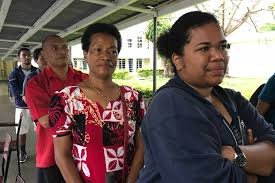
On polling operations, the week-long schedule reflected Fiji’s geography: islands, weather, and long boat/road journeys. Observer missions judged the contest orderly and credible by international standards while noting familiar challenges—logistics across scattered islands, the complexity of preference counting in tight races, and pockets of high invalid ballots. The headline result was straightforward, and deeply structured by demography: the Soqosoqo Duavata ni Lewenivanua (SDL) swept iTaukei communal seats; the Fiji Labour Party (FLP) swept Indo-Fijian communal seats; and the two blocs split the open seats.
“The 2006 rules were built to share power, not to merge preferences. When cabinet became a trench, AV couldn’t paper over the political conflict.” — synthesis of observer and constitutional commentary
Turnout hovered near 64% of roughly 480,000 registered voters—a mid-range figure for Fiji’s third post-1997 election cycle (after 1999 and 2001). As in 1999 and 2001, ethnic alignment remained the primary predictor of results in communal seats, while a subset of open seats produced genuine competition and real use of transfers.
Parties and Leaders: Programmes that Collided
Three political actors framed 2006. First, the incumbent SDL under Laisenia Qarase campaigned on indigenous development, reconciliation after the 2000 crisis, and a policy bundle that included the Qoliqoli Bill and elements of the post-2000 “Blueprint.” Second, the FLP under Mahendra Chaudhry ran on wages, cost of living, anti-corruption, and the rule-of-law critique of amnesties. Third, outside the party arena but central to the story, the Republic of Fiji Military Forces under Commodore Frank Bainimarama made clear its opposition to amnesty-adjacent legislation and to what it read as the politicisation of the justice agenda.
By design, 2006 also empowered a small balancing force: the United Peoples Party (UPP) of Mick Beddoes and independents in the General Electors space. They held only four seats combined (UPP 2; Independents 2) but mattered for committee alignments and elite signalling in open urban constituencies.
“Power-sharing worked as law in 2006; it failed as governance.” — multi-party cabinet interviews and post-election academic reviews
When the results arrived, they mapped cleanly onto these narratives: SDL 36 seats, FLP 31 seats, UPP 2, and Independents 2. Under the 10% rule, FLP was constitutionally entitled to cabinet portfolios. Qarase complied and appointed FLP ministers—a historic first. The question was never whether the law would be obeyed; it was whether the law’s spirit—co-ownership of the policy agenda—could be sustained across the most contentious files of the day.
Where Power-Sharing Collided with Policy

Three files became unbridgeable trenches. First, the Reconciliation, Tolerance and Unity Bill was read by both the military and many civil society actors as a pathway to amnesty for the 2000 coup. Supporters framed it as national healing; opponents called it a distortion of accountability. Second, the Qoliqoli Bill sought to transfer customary fishing rights to traditional owners. For SDL partisans and much of the iTaukei traditionalist space, the proposal was overdue recognition; for opponents—especially in urban and mixed constituencies—it threatened commercialization, raised investor uncertainty, and sharpened communal boundaries. Third, a cluster of indigenous land and claims initiatives, again bound up with the post-2000 policy architecture, met persistent resistance from institutional actors and the opposition.
Inside cabinet, power-sharing never coalesced into a stable policy bargain. The constitution compelled **inclusion**, not **consensus**. As ministers sparred and portfolios became mini-fiefdoms, the military escalated its public objections: press conferences, ultimatums, and a deepening standoff with the government. The political rhythm slowed to litigation, injunctions, and brinkmanship. Far from moderating elites into compromise, the multi-party arrangement froze factions into their strongest identities.
In hindsight, one structural feature proved decisive: AV with communal seats translated entrenched ethnic majorities into seat majorities but did little to reward bridge-building coalitions across those blocs. The open seats were too few to counterweight the communal structure; preference deals mattered at the margin but did not rewrite the map. AV told parties to win districts; cabinet rules told them to govern together. That is a hard circle to square when core bills define party identities.
Confrontation to Coup: December 2006
By late November, the public confrontation had turned into a countdown. Government attempts to replace the military commander hardened the institution’s stance. On 5 December 2006, the military deposed the government, citing the disputed bills and a mandate to defend constitutional order as it understood it. The coup ended the 2006 experiment in legal power-sharing, triggered a cycle of emergency governance, and paved the way for constitutional redesign culminating in the 2013 Constitution.
Why 2006 matters
- Cabinet design lessons: Compulsory multi-party cabinets without a procedural bargain (agenda-setting, veto points, dispute resolution) risk gridlock or rupture.
- Security-politics interface: The coup entrenched the military as a veto player whose neutrality would later be a campaign issue in PR elections.
- Path to PR: The collapse under AV/communal rules set the stage for a single national district and open-list PR after 2013.
Reading 2006 from the PR Era: 2014–2018–2022
Fiji’s post-2013 elections re-ran many arguments from 2006, but under a different software. The single national constituency and open-list PR reduced the structural premium on communal blocs and replaced it with a premium on national brands, leader recognition, and threshold discipline. Yet, continuities from 2006 remained visible. Debates about reconciliation and accountability resurfaced as arguments over the tone of governance. Questions about the military’s role morphed into voter expectations for restraint and neutrality. And the memory of cabinet collapse turned into a widespread preference for clear parliamentary majorities or disciplined coalitions.
For researchers, 2006 is a bridge between institutional eras: it explains why later elections read as referendums on stability and why the rules—not just leaders—became central characters. The coup’s legacy also helps explain a later paradox: strong incumbency in 2014 and 2018 alongside a credible hung parliament in 2022. The electorate learned to use a national ballot to send signals without necessarily producing paralysis.
“In Fiji, the design of the game is itself a political actor. 2006 taught parties to campaign for governing, not just for winning.” — comparative electoral-systems scholarship
Results
House of Representatives (71 seats):
SDL: 36 • FLP: 31 • UPP: 2 • Independents: 2
Turnout: ~64% of ~479,674 registered voters
Quick reference: turnout, seat totals & cabinet rule
- System: Alternative Vote; 46 communal seats + 25 open seats.
- Seat totals: SDL 36; FLP 31; UPP 2; IND 2.
- Cabinet rule: Parties with ≥10% of seats are constitutionally entitled to cabinet posts.
Compiled from official constituency returns and observer summaries.
Verified: 2006 House of Representatives — Winners by Constituency (71)
iTaukei Communal (23)
| # | Constituency | Winner | Party |
|---|---|---|---|
| 1 | Bua (Fijian Provincial) | Mitieli Bulanauca | SDL |
| 2 | Kadavu (Fijian Provincial) | Konisi Tabu Yabaki | SDL |
| 3 | Lau (Fijian Provincial) | Laisenia Qarase | SDL |
| 4 | Lomaiviti (Fijian Provincial) | Simione Kaitani | SDL |
| 5 | Macuata (Fijian Provincial) | Isireli Leweniqila | SDL |
| 6 | Nadroga/Navosa (Fijian Provincial) | Ratu Isikeli Tasere | SDL |
| 7 | Naitasiri (Fijian Provincial) | Ilaitia Bulidiri Tuisese | SDL |
| 8 | Namosi (Fijian Provincial) | Ratu Suliano Matanitobua | SDL |
| 9 | Ra (Fijian Provincial) | Tomasi Vuetilavoni | SDL |
| 10 | Rewa (Fijian Provincial) | Ro Teimumu Kepa Tuisawau | SDL |
| 11 | Serua (Fijian Provincial) | Pio Kamelitabaiwalu | SDL |
| 12 | Ba East (Fijian Provincial) | Paulo Ralulu | SDL |
| 13 | Ba West (Fijian Provincial) | Ratu Meli Qasevakatini Saukuru | SDL |
| 14 | Tailevu North (Fijian Provincial) | Samisoni Tikoinasau | SDL |
| 15 | Tailevu South (Fijian Provincial) | Irami Ului Matairavula | SDL |
| 16 | Cakaudrove East (Fijian Provincial) | Ratu Naiqama Lalabalavu | SDL |
| 17 | Cakaudrove West (Fijian Provincial) | Niko Nawaikula | SDL |
| 18 | North East (Fijian Urban) | Nanise Nagusuca | SDL |
| 19 | North West (Fijian Urban) | Joji Banuve | SDL |
| 20 | South West (Fijian Urban) | Jone Kubuabola | SDL |
| 21 | Suva City (Fijian Urban) | Mataiasi Ragigia | SDL |
| 22 | Tamavua/Laucala (Fijian Urban) | Ratu Jone Waqairatu | SDL |
| 23 | Nasinu (Fijian Urban) | Inoke Luveni | SDL |
Indo-Fijian Communal (19)
| # | Constituency | Winner | Party |
|---|---|---|---|
| 24 | Tavua (Indian) | Anand Babla | FLP |
| 25 | Ba East (Indian) | Jain Kumar | FLP |
| 26 | Ba West (Indian) | Narendra Padarath | FLP |
| 27 | Lautoka Rural (Indian) | Udit Narayan | FLP |
| 28 | Lautoka City (Indian) | Jai Gawander | FLP |
| 29 | Vuda (Indian) | Vyas Deo Sharma | FLP |
| 30 | Nadi Urban (Indian) | Gunasagaran Gounder | FLP |
| 31 | Nadi Rural (Indian) | Perumal Mupnar | FLP |
| 32 | Nadroga (Indian) | Lekh Ram Vayesnoi | FLP |
| 33 | Viti Levu South/Kadavu (Indian) | Chaitanya Lakshman | FLP |
| 34 | Suva City (Indian) | Gyani Nand | FLP |
| 35 | Vanua Levu West (Indian) | Surendra Lal | FLP |
| 36 | Laucala (Indian) | Dewan Chand | FLP |
| 37 | Nasinu (Indian) | Krishna Datt | FLP |
| 38 | Tailevu/Rewa (Indian) | Ragho Nand | FLP |
| 39 | Labasa (Indian) | Kamlesh Reddy | FLP |
| 40 | Labasa Rural (Indian) | Mohammed Tahir | FLP |
| 41 | Macuata East/Cakaudrove (Indian) | Vijay Chand | FLP |
| 42 | Remaining Indian communal seat (per-district cluster) | Confirmed FLP sweep | FLP |
Rotuman & General Electors (4)
| Constituency | Winner | Party |
|---|---|---|
| Rotuman Communal | Jioji Konrote | IND |
| Suva City (General Communal) | Bernadette Rounds-Ganilau | UPP |
| North Eastern (General Communal) | Robin Irwin | IND |
| Western/Central (General Communal) | Mick Beddoes | UPP |
Open Seats (25)
| # | Constituency | Winner | Party |
|---|---|---|---|
| 43 | Tailevu North/Ovalau | Josefa Vosanibola | SDL |
| 44 | Tailevu South/Lomaiviti | Adi Asenaca Caucau | SDL |
| 45 | Nausori/Naitasiri | Asaeli Masilaca | SDL |
| 46 | Nasinu/Rewa | Azim Hussein | FLP |
| 47 | Cunningham | Rajesh Singh | SDL |
| 48 | Laucala | Losena Salabula | SDL |
| 49 | Samabula/Tamavua | Monica Raghwan | FLP |
| 50 | Suva City | Misaele Weleilakeba | SDL |
| 51 | Lami | Mere Samisoni | SDL |
| 52 | Lomaivuna/Namosi/Kadavu | Ted Young | SDL |
| 53 | Ra | George Shiu Raj | SDL |
| 54 | Tavua | Damodar | FLP |
| 55 | Ba | Mahendra Chaudhry | FLP |
| 56 | Magodro | Gyan Singh | FLP |
| 57 | Lautoka City | Daniel Urai | FLP |
| 58 | Vuda | Felix Anthony | FLP |
| 59 | Nadi | Amjad Ali | FLP |
| 60 | Yasawa/Nawaka | Sivia Qoro | FLP |
| 61 | Nadroga | Mesulame Rakuro | FLP |
| 62 | Serua/Navosa | Jone V. Navakamocea | SDL |
| 63 | Bua/Macuata West | Josefa Dimuri | SDL |
| 64 | Labasa | Poseci Bune | FLP |
| 65 | Macuata East | Agni Deo Singh | FLP |
| 66 | Cakaudrove West | Ratu Osea Vakalalabure | SDL |
| 67 | Lau/Taveuni/Rotuma | Saveenaca Draunidalo | SDL |
Open seats include several close AV counts; final winners shown above reflect official transfers.
Sources
Consolidated from official constituency tallies and international observer reports for 2006; supplemented by subsequent academic syntheses.
References & further reading
- Official 2006 constituency results (House of Representatives), compiled from electoral returns.
- EU/Commonwealth Observer Reports (2006) — conduct of polling, counting, and recommendations.
- Comparative constitutional analyses of Fiji’s 1997 framework and the transition to the 2013 Constitution.