
Table of Contents
Fiji’s 1987 Election and Coups: A Watershed that Rewired Politics, Power, and Belonging
1987 is the hinge year in Fiji’s modern history. In April, an unprecedented NFP–FLP coalition won under a system built to encourage cross-community consent. Barely a month later, a military coup shattered that mandate, toppled Prime Minister Timoci Bavadra, and set off a decade of constitutional rupture, migration, and contested nationhood. What had looked like a pragmatic reset toward shared government became a test of whether democratic majorities could survive fear, elite resistance, and the hard weather of identity politics.
The System Fiji Voted Under — and Why a Coalition Could Win
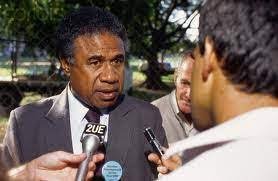
briefly in office before the coup. Wikimedia (CC)
The House Fiji inherited from independence combined communal seats with cross-voting seats. Communal seats were elected from ethnic rolls; the cross-voting seats required candidates to be of a nominated community but were elected by the whole electorate. The theory was simple: force parties to find votes across the communal seam and reward moderate bargaining. It did not erase ethnic arithmetic, but it made coalition-building a rational strategy.
By the mid-1980s, several currents converged. Economic unease, public-service morale issues, and frustrations with the long-standing Alliance Party opened space for a rival alignment. The newly formed Fiji Labour Party (FLP) brought a social-democratic critique — cost-of-living, wage justice, clean government — and a language of dignity that resonated with workers of every background. The National Federation Party (NFP), the older Indo-Fijian vehicle, contributed experience, organisational depth, and a reformist constitutional imagination. Together, the NFP–FLP coalition presented something Fiji had not yet seen at scale: a campaign that asked voters of all communities to share a practical government.
“The ballot box briefly outran the old map. For a season, Fiji chose a cabinet that looked like a negotiated future.” Contemporary editorial, April 1987
That invitation landed. The coalition was competitive not only in the communal arithmetic but, crucially, in the cross-voting seats, where persuasion mattered more than mobilisation. The Alliance, led by Ratu Sir Kamisese Mara, still commanded deep loyalties in chiefly networks and among General Electors, but the coalition’s case for fairness, competence, and a more relaxed public culture gained momentum.
Campaign Lines — and the April Result
FLP framed the election around bread-and-butter issues: a tighter anti-corruption stance, fairer wage councils, and a social compact that felt less patronage-bound. NFP stressed institutions — independent courts, professional public service, trust-building with iTaukei leadership — and macro prudence. The Alliance countered with stability, chiefly stewardship, and its record of development. It warned that too-rapid change would unsettle identity and property arrangements that anchored iTaukei security.
The result surprised many: the NFP–FLP coalition won a parliamentary majority. Dr Timoci Bavadra, a physician from Nadroga with a modest style and a reformist cabinet, was invited to form a government. Early signals were purposeful but calm: tighten ethics rules, reset tone with the media, bring down inflationary anxieties, and demonstrate that a multiethnic cabinet could govern without drama.
Why the victory mattered:
- It proved that cross-ethnic consent was not just rhetorical; it could produce a working majority.
- It widened the idea of who could speak for “the nation,” including Indo-Fijian leaders in central portfolios.
- It challenged a style of government felt by many to be more deferential than responsive.
May 14, 1987: The First Coup
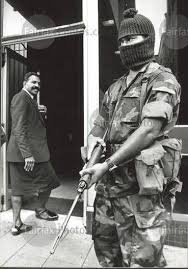
on that fateful day. Wikimedia (CC)
On the morning of 14 May 1987, soldiers under Lieutenant Colonel Sitiveni Rabuka entered Parliament and detained Prime Minister Bavadra and his ministers. In a single hour, the claims of a ballot-born government collided with an assertion that iTaukei political pre-eminence must not be threatened, whatever the count. The country jolted: businesses closed early; radios carried clipped statements; families scanned for curfews and trouble. Fiji’s image abroad — tolerant, orderly, hospitable — strained against the fact that the army had unseated Parliament.
In the first weeks, there were efforts to stabilise: the military spoke of temporary stewardship; the language of protecting tradition competed with the language of constitutionalism. The Governor-General, Ratu Sir Penaia Ganilau, tried to broker a civilian path back — a caretaker arrangement, a rebalanced cabinet, a way to honour the electorate while cooling fear. Indo-Fijian communities, stunned but organised, debated tactics: street protest vs restraint, international advocacy vs quiet lobbying, strikes vs service continuity. Churches and civic bodies were divided; some voiced relief at a perceived restoration of order, others warned that a coup against a lawful government could not be squared with the rule of law.
“The coup was not only a seizure of buildings; it was a seizure of the conversation — about who belongs, who decides, and whether votes can overrule fear.” Human rights advocate, mid-1987
Between Two Coups — Negotiation, Hope, Collapse
For a time, there appeared to be a bridge back. Under the Deuba understanding, mediated by the Governor-General, a pathway to a broadly based government was tentatively mapped out: a measure of power-sharing, guarantees for iTaukei institutions, a calmer pace of change. The Bavadra side was willing to make concessions in the national interest. The Alliance elite was not monolithic; some saw the necessity of a constitutional landing zone.
But the deeper contest — over who legitimately spoke for the state — persisted. On 25 September 1987, a second coup was staged. The brittle compromise gave way to a military-dominated transition that would soon declare Fiji a republic and abrogate the independence-era constitutional arrangements.
Quick reference: Deuba to Republic (timeline)
- May–July: Governor-General seeks a caretaker, power-sharing formula; intermittent detentions and media controls.
- August: Deuba talks outline a broad-based cabinet; fragile optimism, strong headwinds.
- 25 September: Second military takeover; negotiations collapse.
- October–December: Republic declared; independence-era constitution set aside; international censure mounts.
The interlude showed that compromise was imaginable but not yet sustainable against hardliners and the momentum of force.
Consequences: Law, Economy, Demography, and the Intimate Fabric of Life
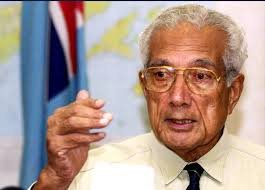
suspicion of involvement in coup lingers. Wikimedia (CC)
Constitutional direction. The independence-era design that had blended communal representation with cross-voting seats was overturned. A new constitutional trajectory privileged permanent ethnic balance over electoral fluidity. The principle that a multiethnic parliamentary majority could legitimately govern — however carefully it pledged to protect customs and land — was, in practice, set aside.
Civic and human rights. Detentions, press restrictions, and emergency regulations arrived in waves. Trade unions faced a narrower space; public servants navigated loyalty checks. A language of moral order circulated — sabbath restrictions, public rhetoric about respect — and for some communities it felt like reassurance. For others it felt like a script of control written to justify a broken promise to voters.
Economy and migration. Investment paused; professional families weighed futures; a substantial outflow of Indo-Fijians gathered pace over the ensuing years. Sugar, the labour market, and small business showed the strain. The loss was not only numeric; it was cumulative in experience, social capital, and the everyday cosmopolitanism of mixed neighbourhoods.
Religion and culture. Churches were not of one mind. Some leaders endorsed the coup’s aims; others, including within the same denominations, insisted that justice and consent were non-negotiable Christian commitments. Hindu and Muslim bodies, Indo-Fijian civic groups, and many iTaukei moderates channelled their energies into calm, persistent advocacy for a constitutional repair.
“1987 did not invent division; it licensed it. Rebuilding meant proving, patiently, that dignity is indivisible — and that security without equality is never secure.” Scholar-activist, late 1980s
Indo-Fijian Resistance, Resilience — and the Choice Not to Disappear
From the first hours after the coup, Indo-Fijian organisations faced a harsh calculus. Street confrontation risked casualties and ethnic spiral; silence risked normalising the new order. The response mixed legal challenge, international advocacy, and a deliberately non-provocative domestic posture that kept families safe while refusing invisibility. Unions issued statements and, where possible, pursued industrial leverage. Community leaders redirected energy to schools, social welfare, and diaspora networks. The message was principled but practical: we will not fuel a fire — but we will not accept that votes do not count.
This stance would shape the 1990s. In 1992 and 1994, under rules widely criticised as discriminatory, Indo-Fijian parties nonetheless contested, arguing that representation inside Parliament and persuasion outside it were not enemies but twins. The resilience that showed in those elections was born in the winter of 1987: a refusal to surrender either dignity or democratic method.
International Reaction and Fiji’s Place in the World
Neighbours, Commonwealth partners, and multilateral institutions responded with a blend of disappointment and quiet diplomacy. Aid and trade were not turned off overnight, but doors cooled. The language of isolation hovered. Fiji’s brand — as an exporter of peacekeepers and hospitality — sat uneasily with headlines about soldiers in Parliament. Over the longer run, investment would track the rhythm of reform talk; each step toward constitutional repair unclenched one more fist.
What Fiji Lost — and What It Learned
Trust is the most delicate currency in politics. 1987 spent it lavishly in a single day. Schools kept teaching; hospitals kept treating; buses kept running. But the invisible mesh that lets people imagine a common future — the conviction that rules bind the strong as well as the weak — frayed.
And yet: something else took root. Moderate leaders across communities began to speak a little more plainly about the paradox of security: that only equal dignity makes anyone safe. The seeds of the 1997 constitutional settlement — flawed, partial, but real — were sown in the stubbornness of those who refused either triumphalism or despair. They argued that a multiethnic cabinet was not an affront to tradition but its best protection in a modern state.
Long arc takeaway:
- 1987 proved how quickly rules can be unmade — and how long it takes to remake trust.
- Resistance can be principled and careful at the same time; survival and solidarity are not opposites.
- In Fiji, the path back has always run through relationships as much as texts. Compacts are negotiated daily, not just drafted once.
Voices and Vectors: People Who Shaped 1987
Timoci Bavadra was the unlikely architect of a gentler politics: a clinician’s attention to detail, a trade unionist’s patience, and a reformer’s conviction that fairness is efficient. Mahendra Chaudhry sharpened the FLP’s economic critique and held a line on labour dignity that would echo into 1999. Jai Ram Reddy brought legal precision and, later, a statesman’s appetite for settlement. Ratu Sir Kamisese Mara, the post-independence steward, wrestled with the changing centre of gravity. Sitiveni Rabuka became the face of rupture — and, in later decades, would attempt a very Fijian kind of reconciliation with the idea of shared rule.
Beyond these names were teachers, nurses, cane farmers, civil servants, and clergy who absorbed the shock and kept a society going. Their everyday decisions — to stay, to serve, to argue without hating — made recovery imaginable.
Verified: 1987 Elected Members of the House (Supplied List)
The list below is merged from your project notes for the 1987 House. Constituency tags were supplied as “Various”; we present party and community columns for clarity.
Show/hide the verified MPs table (1987)
| # | Member | Community | Party |
|---|---|---|---|
| FLP / Coalition Bench | |||
| 1 | Timoci Bavadra | Mixed (Indo-Fijian & Fijian) | FLP |
| 2 | Mahendra Chaudhry | Mixed (Indo-Fijian & Fijian) | FLP |
| 3 | Krishna Datt | Mixed (Indo-Fijian & Fijian) | FLP |
| 4 | Tupeni Baba | Mixed (Indo-Fijian & Fijian) | FLP |
| 5 | David Pickering | Mixed (Indo-Fijian & Fijian) | FLP |
| 6 | Satendra Nandan | Mixed (Indo-Fijian & Fijian) | FLP |
| 7 | Jone Navakamocea | Mixed (Indo-Fijian & Fijian) | FLP |
| 8 | Kamal Iyer | Mixed (Indo-Fijian & Fijian) | FLP |
| 9 | Manikam Pillay | Mixed (Indo-Fijian & Fijian) | FLP |
| 10 | Ramesh Chand | Mixed (Indo-Fijian & Fijian) | FLP |
| 11 | Anand Singh | Mixed (Indo-Fijian & Fijian) | FLP |
| 12 | Vijay Naidu | Mixed (Indo-Fijian & Fijian) | FLP |
| 13 | Shiu Narayan | Mixed (Indo-Fijian & Fijian) | FLP |
| 14 | Pratap Chand | Mixed (Indo-Fijian & Fijian) | FLP |
| 15 | Shamshu Dean | Mixed (Indo-Fijian & Fijian) | FLP |
| National Federation Party (NFP) | |||
| 16 | Jai Ram Reddy | Indo-Fijian | NFP |
| 17 | Harish Sharma | Indo-Fijian | NFP |
| 18 | Karam Ramrakha | Indo-Fijian | NFP |
| 19 | Vinod Patel | Indo-Fijian | NFP |
| 20 | Shiromaniam Madhavan | Indo-Fijian | NFP |
| 21 | Mohammed Sadiq | Indo-Fijian | NFP |
| 22 | Anand Babla | Indo-Fijian | NFP |
| 23 | Raman Pratap Singh | Indo-Fijian | NFP |
| 24 | Udit Narayan | Indo-Fijian | NFP |
| 25 | Sharda Nand | Indo-Fijian | NFP |
| 26 | Narendra Kumar | Indo-Fijian | NFP |
| 27 | Ram Sharan | Indo-Fijian | NFP |
| 28 | Vijay Parmanandam | Indo-Fijian | NFP |
| Alliance / General & Fijian Benches | |||
| 29 | Ratu Sir Kamisese Mara | Fijian/General | Alliance |
| 30 | Tomasi Vakatora | Fijian/General | Alliance |
| 31 | Filipe Bole | Fijian/General | Alliance |
| 32 | Josevata Kamikamica | Fijian/General | Alliance |
| 33 | Ratu Penaia Ganilau | Fijian/General | Alliance |
| 34 | Ratu David Toganivalu | Fijian/General | Alliance |
| 35 | Ratu Ovini Bokini | Fijian/General | Alliance |
| 36 | Ratu Jone Yavala Kubuabola | Fijian/General | Alliance |
| 37 | Ratu Joeli Nacola | Fijian/General | Alliance |
| 38 | Militoni Leweniqila | Fijian/General | Alliance |
| 39 | Emosi Vuakatagane | Fijian/General | Alliance |
| 40 | Ilai Kuli | Fijian/General | Alliance |
| 41 | Solomone Naivalu | Fijian/General | Alliance |
| 42 | Apenisa Kurisaqila | Fijian/General | Alliance |
| 43 | Mosese Tuisawau | Fijian/General | Alliance |
| 44 | Mesulame Narawa | Fijian/General | Alliance |
| 45 | William Toganivalu | Fijian/General | Alliance |
| 46 | Isikeli Nadalo | Fijian/General | Alliance |
| 47 | Ratu Josefa Dimuri | Fijian/General | Alliance |
| 48 | Savenaca Draunidalo | Fijian/General | Alliance |
| 49 | John Falvey | Fijian/General | Alliance |
| 50 | James Ah Koy | Fijian/General | Alliance |
| 51 | Benjamin Wise | Fijian/General | Alliance |
| 52 | Paul Manueli | Fijian/General | Alliance |
Presented exactly as supplied; constituency column was “Various” in your source.
The Long Arc from 1987 to the 1990s — and Beyond
By the early 1990s, Fiji’s political architecture had been recast. The 1990 Constitution entrenched communal representation and tilted the arithmetic decisively. Many Indo-Fijians experienced this not as reassurance but as institutionalised second-class citizenship. And yet, the broad strategy that communities had chosen in 1987 — resist without burning bridges — persisted. In 1992 and 1994, Indo-Fijian parties contested under protest, building parliamentary presence while making the case for reform. The eventual 1997 settlement did not perfect Fiji’s democracy, but it restored the idea that government must be accountable to all its people, not to fear.
1987 thus sits at the headwaters of two rivers. One is the story of rupture: the coups, the brain drain, the narrowing of public speech. The other is the story of repair: the patient knitting together of a vocabulary in which iTaukei guardianship and Indo-Fijian dignity are not hostile claims but joint conditions for a liveable state. Later crises would test that claim again. But each time Fiji returned to the polls and allowed a multiethnic cabinet to stand, it drew on skills learned in the long shadow of 1987: humility in victory, persistence in loss, and a bias for conversation over force.
Sources & further reading
- Parliamentary records and press coverage of the April 1987 general election.
- Governor-General statements and contemporary reporting on the May and September coups.
- Party manifestos and union documents (NFP, FLP, Alliance) from 1986–1987.
- Analytical syntheses on the 1990 and 1997 constitutional settlements.
MPs table reflects your supplied list; narrative integrates widely reported events and themes.