

Table of Contents
Fiji Legislative Council Election — 1956: Colonial Order Under Strain
The 1956 Legislative Council election was another step in Fiji’s slow and cautious transition from colonial rule.
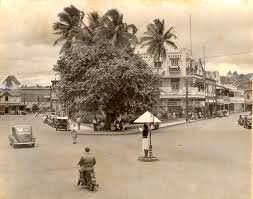
a colonial capital. (Wikimedia Commons)
Like the contests before it, the franchise was tightly restricted, and most of the population remained excluded from the vote. Yet the election revealed growing Indo-Fijian demands for equality, the consolidation of European power through the General Electors, and the careful management of indigenous Fijian representation through the chiefly system. Though the results were predictable, the 1956 poll highlighted the tensions that would soon make reform unavoidable.
Context: A Colonial System with Limited Reform
In 1956 Fiji remained a British colony administered by a Governor with sweeping powers. The Legislative Council was composed of elected members, nominated representatives, and colonial officials, but ultimate authority rested with the Governor and his appointed executive. The franchise was limited to property-owning, literate males, effectively restricting voting to a tiny elite. Women, rural labourers, and the majority of Indo-Fijian cane farmers and indigenous Fijian villagers were excluded.
Representation was strictly communal: nine seats for General Electors (Europeans and other minorities), nine for Indo-Fijians, and a single elected Fijian seat, with additional Fijians nominated by the Governor. This structure ensured that Europeans retained disproportionate political weight, while Indo-Fijians — nearly half of the population — remained under-represented. Fijian representation continued to be channelled through chiefs, reflecting the colonial strategy of ruling through traditional authority.
Colonial Election Style in 1956
- Restricted franchise: Only property-owning, literate men could vote.
- Small electorate: Turnout was tiny compared to Fiji’s population of nearly half a million.
- Communal representation: Europeans, Fijians, and Indo-Fijians had separate rolls and seats.
- No parties: Candidates ran as independents, though leaders like A. D. Patel gave Indo-Fijians a collective voice.
- Governor’s control: With nominated and official members, colonial authorities ensured they always held the balance of power.
The Campaign: Quiet but Tense
The 1956 campaign lacked the spectacle of mass rallies that would characterise later elections. Instead, it was conducted in small community halls, newspapers, and through personal networks. European candidates, representing General Electors, focused on protecting economic privileges and opposing rapid reform. They campaigned on stability, warning against granting more rights to Indo-Fijians.
Indo-Fijian candidates, led by A. D. Patel, used the campaign to highlight inequality. Patel and his allies called for a “common roll” — one person, one vote — and pressed for better land lease terms for cane farmers. They knew the electorate was small and privileged, but they used the platform to mobilise opinion in the wider community.
Fijian candidates were largely chiefs endorsed by the colonial government. Campaigning was minimal; the Governor and the Great Council of Chiefs ensured that Fijian representation aligned with colonial priorities. Many ordinary Fijians remained unaware that an election was taking place, as it had little bearing on their daily lives.
Results: Predictable Outcomes, Growing Voices
As expected, General Electors retained strong representation, securing all nine of their allocated seats. Indo-Fijians filled their nine seats, with Patel and other reformists ensuring that the call for equality was voiced in Council. The single elected Fijian seat went to a chiefly figure acceptable to both the Governor and the Great Council of Chiefs.
Out of 37 members in total, only 19 were elected, with the remainder being officials or nominees. This guaranteed that colonial authorities and European settlers retained control. Still, the Indo-Fijian bloc became more assertive in 1956, signalling that the era of passive representation was over.
| Group | Elected Seats | Notes |
|---|---|---|
| General Electors (Europeans) | 9 | Retained dominance, conservative voice |
| Indo-Fijians | 9 | Led by A. D. Patel, pressed for reform |
| Fijians | 1 | Chiefly representative, colonial-approved |
| Nominated & Official | 18 | Appointed by Governor, maintained control |
Aftermath: Rising Demands for Reform
The 1956 election changed little in terms of governance, but it sharpened political debate. Patel used his seat to challenge the communal system and call for common roll. Europeans resisted, fearing loss of dominance, while chiefs argued that land and tradition must remain protected.
The limits of the 1956 system were increasingly obvious. By the late 1950s, international pressure for decolonisation was mounting, and Indo-Fijians were mobilising in greater numbers outside the electoral system. The colonial authorities recognised that reform could not be postponed indefinitely.
Legacy: A Colony on the Edge of Change
The 1956 Legislative Council election is remembered as part of the “colonial twilight.” It preserved the status quo but also made clear that change was inevitable. Indo-Fijian leaders emerged more determined, Fijian chiefs consolidated their role, and Europeans clung to privilege. Within seven years, universal male franchise would arrive, transforming Fiji’s politics in 1963.
“1956 was colonial Fiji at a crossroads — still ruled by a narrow elite, but with the rumble of change just beneath the surface.” — Historian, University of the South Pacific
Legislative Council Membership — 1956 Election (37 seats)
Source: “List of members of the Legislative Council of Fiji (1956–1959)” — official records.
General Electors (Europeans & Others) — 9 elected
| # | Constituency | Member |
|---|---|---|
| 1 | Eastern | Charles Walker |
| 2 | Northern | Bill Clark |
| 3 | Southern | Charles Stinson |
| 4 | Western | Edward Beddoes |
| 5 | Suva Urban | James Ah Koy |
| 6 | Levuka | Bruce Ragg |
| 7 | Lautoka | Ronald Ragg |
| 8 | Labasa | Peter Sloan |
| 9 | Ba | John Falvey |
Indo-Fijians — 9 elected
| # | Constituency | Member |
|---|---|---|
| 10 | Ba | Siddiq Koya |
| 11 | Ba Rural | Sarvan Singh |
| 12 | Lautoka | Jai Ram Reddy |
| 13 | Lautoka Rural | K. C. Ramrakha |
| 14 | Labasa–Bua | A. D. Patel |
| 15 | Nadi | H. M. Lodhia |
| 16 | Nasinu–Vunidawa | Chandra Pal Singh |
| 17 | Nausori–Levuka | James Madhavan |
| 18 | Sigatoka | Harish Sharma |
Fijians — 1 elected (chiefly)
| # | Constituency | Member |
|---|---|---|
| 19 | Eastern Fijian seat | Ratu Penaia Ganilau |
Nominated & Official Members — 18 appointed by Governor
| # | Name | Position / Background |
|---|---|---|
| 20 | Sir Ronald Garvey | Governor & Council President |
| 21 | Sir John Falvey | Attorney-General |
| 22 | Ratu Sir George Cakobau | Paramount Fijian chief |
| 23 | Colonial Secretary | British official |
| 24 | Financial Secretary | British official |
| 25 | Director of Agriculture | British official |
| 26 | Director of Medical Services | British official |
| 27 | Other European appointees (x4) | Settler nominees |
| 31 | Other Fijian appointees (x4) | Chiefly nominees |
| 35 | Other Indo-Fijian appointees (x2) | Community nominees |
Totals: 19 elected (9 General, 9 Indo-Fijian, 1 Fijian) + 18 nominated/official. This structure maintained colonial control despite the appearance of elections.